

PCB Recycling & Precious Metal Recovery From Circuit Boards
Industrial E-Waste › PCB Recycling
Printed circuit boards carry most of the value in electronic scrap: copper in every trace and layer, and small amounts of gold, silver and palladium in connectors, contacts and components. Khanija Resource Recovery specialises in PCB recycling and precious metal recovery at our facility in Malur, near Bengaluru. We buy circuit board scrap from manufacturers, PCB fabricators, factories and scrap traders across India, from rejected production boards and bare PCBs to industrial control boards and motherboards, and pay a fair price based on recovery value. We facilitate 100% compliant disposal, and you receive the documentation as per Pollution Control Board norms.
Who we buy PCB scrap from
PCB scrap comes mainly from industry: manufacturers, fabricators and plants that generate loose boards as part of their work. We buy from:
Electronics manufacturers and EMS companies
Boards that fail testing, rework scrap, end-of-line and obsolete stock, and panel offcuts from SMT lines.
PCB fabricators
Rejected bare boards, panel rails and edge trimmings, test coupons and excess inventory.
Factories and plants
Control boards removed during automation upgrades and maintenance: PLC cards, drive boards, controller boards.
OEMs and service centres
Field returns, replaced boards and spares written off by equipment makers and their service networks.
Dismantlers and refurbishers
Boards removed from equipment that has been taken apart for parts or refurbishment.
Scrap traders and aggregators
Sorted or mixed circuit board lots collected from local markets and dealers.
Circuit boards we buy
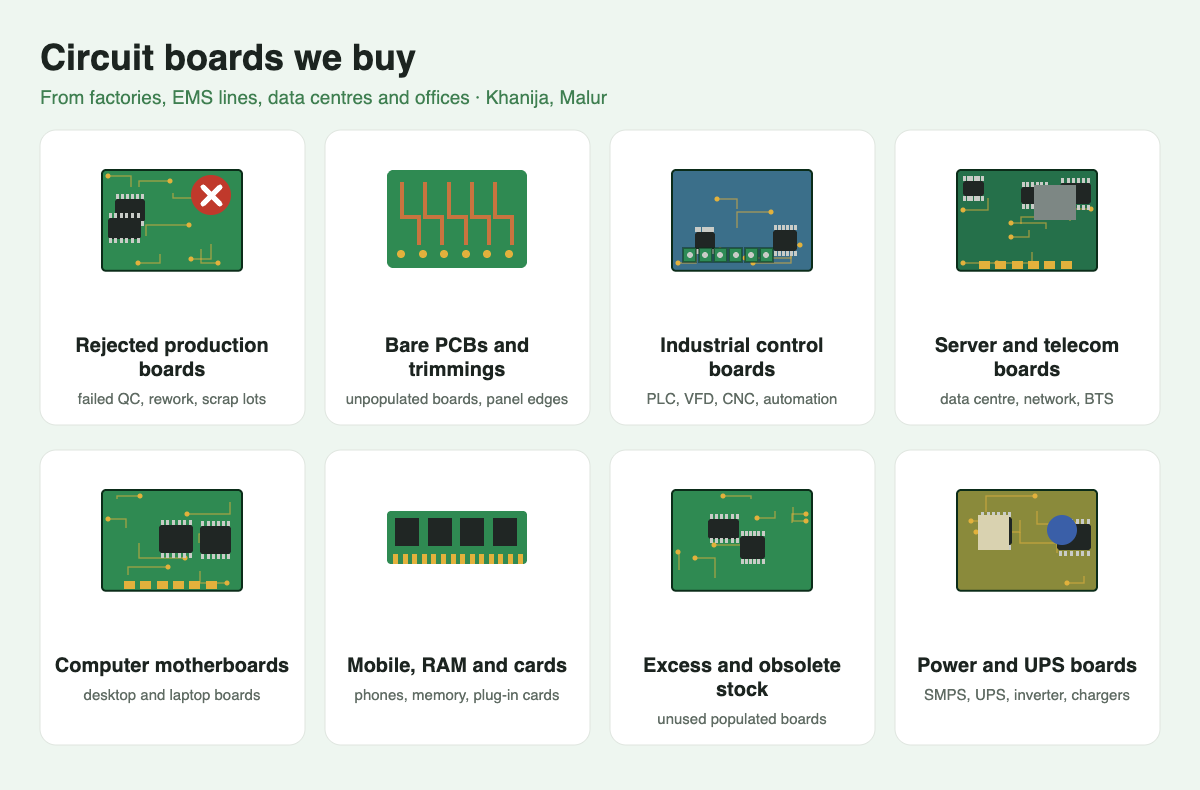
We buy loose populated and bare boards of every type. Keeping each type separate helps us assess the lot faster and pay for what it really contains.
Rejected production boards
Boards that failed AOI, ICT or functional testing, rework failures and scrapped batches from assembly lines.
Bare PCBs and trimmings
Unpopulated boards, fabrication rejects, panel rails, edge cuts and surplus bare board stock.
Excess and obsolete populated boards
Unused boards left after design changes, end-of-life products or cancelled orders.
Industrial control boards
PLC cards, VFD and servo drive boards, CNC controllers, HMI boards and automation electronics.
Server and data centre boards
Server motherboards, storage controllers, backplanes and blade boards.
Telecom and networking boards
Switch and router boards, line cards and base station (BTS) cards.
Computer motherboards
Desktop and laptop motherboards, with or without processors and memory fitted.
Mobile phone and tablet boards
Phone and tablet logic boards from repair centres, refurbishers and collection drives.
RAM modules and plug-in cards
Memory sticks, graphics, network and expansion cards with gold-plated edge connectors.
Hard drive and SSD boards
Drive controller boards; storage devices go through certified data destruction.
Automotive and EV electronics
ECU boards, battery management (BMS) boards and other vehicle electronics.
Power supply, UPS and appliance boards
SMPS, UPS, inverter and charger boards, TV and appliance boards, LED driver boards.
How circuit boards are graded
The recycling trade groups boards by how much precious metal they are likely to carry. We assess every lot on its own, but the broad grades look like this:
| Grade | Typical boards | What drives the value |
|---|---|---|
| High grade | Server and telecom boards, mobile phone boards, RAM modules, cards with gold edge connectors, older PC motherboards | Dense components, gold-plated contacts and connectors, multilayer copper |
| Medium grade | Newer desktop and laptop motherboards, industrial control boards, hard drive boards, most rejected production boards | Copper content and a moderate number of ICs and connectors |
| Low grade | Power supply and UPS boards, TV, appliance and LED driver boards | Mostly copper and solder; large transformers, capacitors and heat sinks add weight but little precious metal |
| Bare PCB | Unpopulated boards, fabrication rejects, panel trimmings | Copper laminate; gold or silver surface finishes add value |
Every lot is different, so we quote after seeing the boards, photos or a sample.
What is inside a printed circuit board
A circuit board is a layered sheet of glass fibre and epoxy resin with copper foil tracks, carrying soldered components. Studies of waste boards find that metals make up roughly a quarter to a third of their weight. One study of computer boards, published in the journal Materials in 2014, measured about 26–27% metal by weight, including about 14% copper, with gold around 142 grams per tonne and silver around 317 grams per tonne in its sample. The same paper notes that reported gold and silver levels vary widely between board types and have fallen over the years as manufacturers use less precious metal.
Phones show why small boards matter: the US Environmental Protection Agency has estimated that recycling one million mobile phones can recover about 35,274 lbs of copper, 772 lbs of silver, 75 lbs of gold and 33 lbs of palladium.
The rest of the board is glass fibre, resin and other materials, which also need proper handling instead of burning or dumping.
How we recover copper and precious metals from PCBs
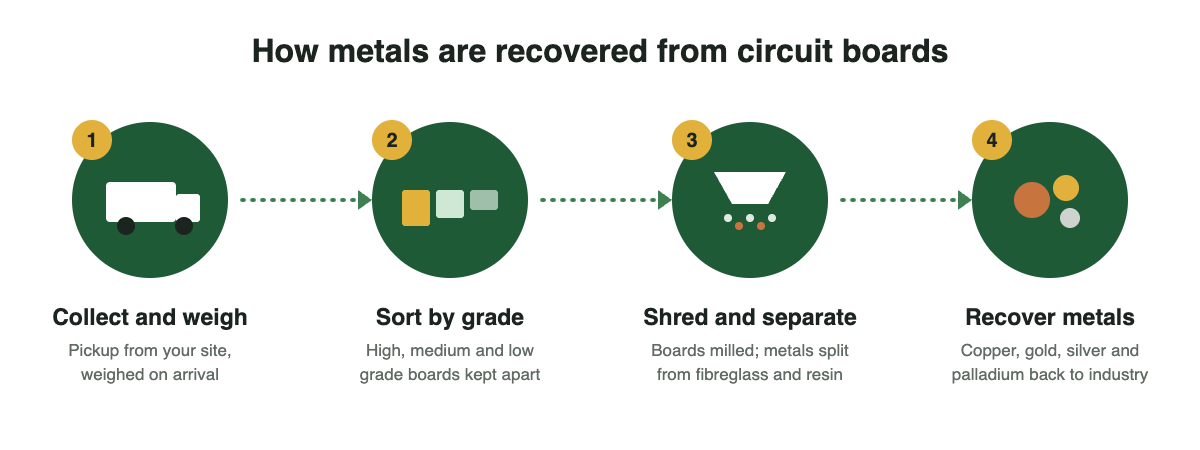
Pickup and weighment
We collect from your factory, warehouse or office across India and weigh every lot on arrival.
Sorting and grading
Boards are sorted by type and grade. Batteries, steel brackets, heat sinks, cables and plastic housings are removed.
Shredding and milling
Boards are shredded and milled into small particles so the metal is freed from the glass fibre and resin.
Separation
Density separation splits the material into a copper-rich metal fraction and a non-metal fibreglass and resin powder.
Metal recovery
The metal fractions go on to recovery, so copper, gold, silver and palladium return to manufacturing instead of being lost.
Why circuit boards should not go to informal scrap yards
Informal recyclers often burn boards in the open or soak them in acid baths to get at the metals. The World Health Organization's fact sheet on e-waste names open burning, heating and acid leaching among informal methods that release lead, mercury and dioxins into air, soil and water, with children and pregnant women most at risk. Selling to a recycler that processes boards mechanically, and gives you documents for every lot, keeps your company's scrap out of that chain.
For manufacturers: rejected and confidential boards
Rejected production boards and prototypes often carry your designs. We shred them for metal recovery, so failed or confidential units do not reappear in the grey market. Boards and devices that hold data, such as drives, SSDs and phone boards, go through certified data destruction, and you receive a data destruction record listing the serial numbers. Regular scrap from SMT and assembly lines can be collected on a monthly or quarterly schedule.
How to prepare your PCB scrap for pickup
- Keep different board types in separate bags or boxes: rejected boards, bare PCBs, motherboards, power boards
- Remove batteries and keep them apart, with terminals taped; we collect them too
- Take boards out of metal and plastic enclosures where you can
- Keep boards dry and away from oil and chemicals
- Share photos and an approximate weight for each type, so we can plan the pickup and quote
How we price circuit board scrap
We pay a fair price based on recovery value. The main factors are the board type and grade, how many components and gold-plated contacts it carries, how much steel, aluminium or plastic is still attached, and the quantity in the lot. Sorted, clean lots are assessed faster. Share photos on WhatsApp for a first estimate.
PCB recycling FAQs
Do you buy bare PCBs with no components?
Yes. We buy unpopulated boards, fabrication rejects, panel rails and trimmings. Their value comes mainly from copper, plus any gold or silver surface finish.
What is the minimum quantity for a pickup?
There is no fixed minimum. Tell us what you have and where. Small lots can be combined with other pickups on the same route; larger factory lots get a dedicated pickup.
Can you collect regularly from our production line?
Yes. Manufacturers can set up a monthly or quarterly pickup for rejected boards and line scrap, and you receive the documentation as per Pollution Control Board norms for every lot.
Will our rejected boards be resold?
No. Rejected production boards are shredded and processed for metal recovery, not resold.
We are retiring old laptops and servers. Is this the right service?
For whole computers, laptops and servers, use our corporate e-waste service. We collect the complete equipment, carry out certified data destruction, and the boards inside are recycled as part of that process.
Do you collect outside Bengaluru?
Yes. We collect from companies across India and process the material at our facility in Malur.
Sources
- Bizzo, W. A., Figueiredo, R. A. and de Andrade, V. F. (2014). Characterization of Printed Circuit Boards for Metal and Energy Recovery after Milling and Mechanical Separation. Materials, 7(6), 4555–4566.
- US Environmental Protection Agency (2010). News release on mobile phone recycling.
- World Health Organization (2024). Electronic waste (e-waste) fact sheet.
Sell your circuit board scrap
Send photos and an approximate weight, and we will plan the pickup and quote based on recovery value. Read more about industrial e-waste recycling.