

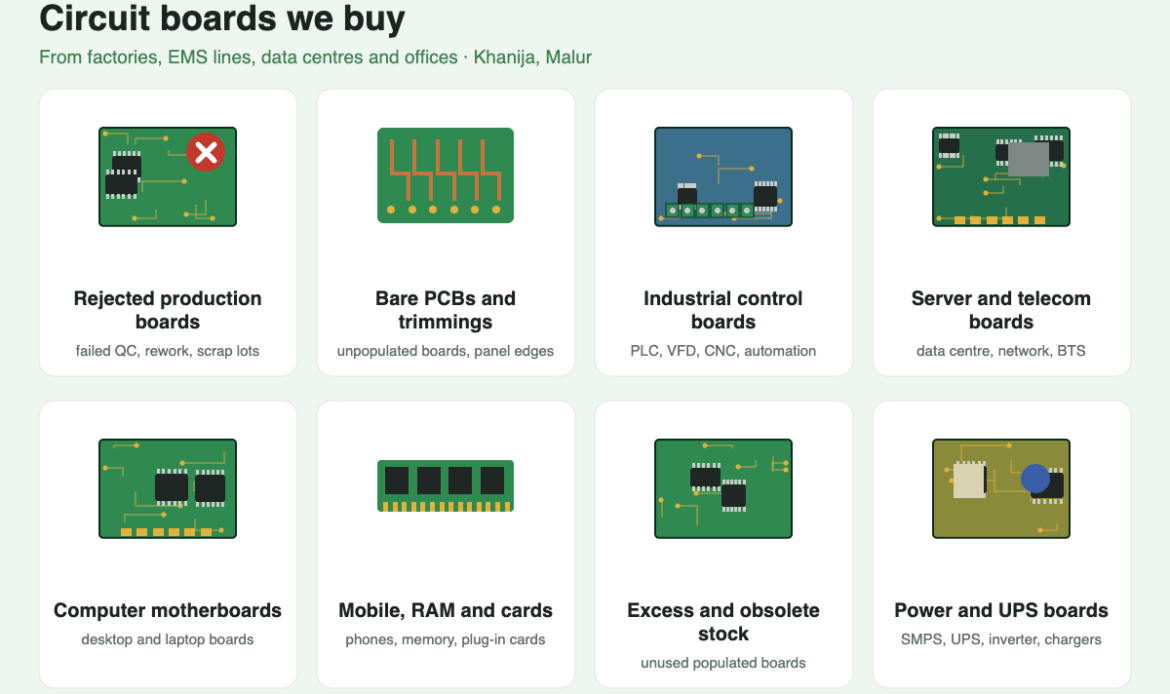
If you trade in circuit board scrap, run a factory or manage a service centre, you have probably noticed that two lots of the same weight can be valued very differently. That is because a PCB is not a single material. It is a mix of fibreglass, resin, copper and, on many boards, small amounts of gold, silver and palladium.
The value of a lot depends on how much of these metals can be recovered from it. This article explains, in plain terms, the main factors that decide that value, so you can sort and sell your scrap with more confidence.
Board type and grade
The scrap trade usually groups circuit boards into broad grades. The exact names vary from buyer to buyer, but the idea is the same everywhere.
High-grade boards
These are boards from equipment that uses more precious metal in its connectors, chips and contacts. Typical examples are:
- Server and networking boards
- Telecom and exchange boards
- Computer motherboards, especially older ones
- Memory modules and add-on cards with gold fingers
- Some industrial control and medical equipment boards
Medium-grade boards
This group includes newer computer motherboards, boards from printers, routers and similar equipment. They have a fair amount of copper and some precious metal, but less than high-grade boards.
Low-grade boards
Low-grade boards come from equipment where cost was kept low and precious metals are used sparingly. Common examples are:
- Power supply boards (SMPS)
- TV and monitor boards
- Boards from small appliances, toys and chargers
- Single-sided boards with large components and heat sinks
Low-grade boards still contain copper and are worth recycling, but their recovery value is lower. Many low-grade boards also carry heavy parts like transformers and aluminium heat sinks, which add weight without adding much precious metal.
Gold-plated connectors and fingers
Gold is used on connector edges (often called gold fingers), contact pads, pins and some chip packages because it does not corrode and conducts well. The gold layer is very thin, but across a large lot it adds up.
Boards with visible gold fingers, such as memory modules, expansion cards and many telecom boards, generally have a higher recovery value. Some traders cut the fingers off and sell them separately as cut fingers, but this needs care. Rough cutting with a lot of board material attached, or mixing in gold-coloured parts that are not actually plated, makes assessment harder.
Components left on the board
Whether a board is populated (with components) or bare also makes a difference. ICs, processors, connectors and certain capacitors contain precious metals, so a fully populated high-grade board usually carries more value than the same board stripped down.
On the other hand, large items such as transformers, heat sinks, steel brackets, batteries and capacitor cans add weight but little recovery value. On low-grade boards especially, these can pull down the value of a lot. If you remove them, keep them separate rather than throwing them back into the board bag.
Batteries must always be removed from boards before sale. They are a safety risk during transport and processing.
Copper content
Copper is present in almost every board, in the copper layers, tracks and through-holes, as well as in connectors and wiring. For many low and medium-grade boards, copper makes up a large share of the recovery value.
Multilayer boards, thick copper boards and dense boards from industrial equipment tend to carry more copper. Bare boards and panel offcuts from PCB fabricators are mainly copper and fibreglass, and are assessed mostly on their copper content. Since copper prices move with the global metal market, the value of copper-rich scrap also changes over time.
Mixing and contamination
Mixing is the most common reason a lot is valued lower than its owner expects. When high-grade and low-grade boards are thrown together, the whole lot is usually assessed closer to the lower grade, because it is not practical to sort every board by hand at pickup.
Contamination also reduces value. Common problems include:
- Plastic casings, metal covers and frames left on the boards
- Cables, wires and loose hardware mixed into the bags
- Wet, muddy or burnt material
- Non-PCB waste such as packaging, paper and general scrap
The simple fix is to segregate at source. Keep high, medium and low-grade boards in separate bags, keep bare boards and offcuts apart, and remove obvious non-board material.
Quantity and consistency of supply
Larger lots are easier to assess, transport and process, which helps the overall value. Consistency matters too. A trader or factory that supplies similar, well-segregated material on a regular schedule is easier to work with than one sending mixed lots at random.
If you generate PCB scrap regularly, a planned pickup schedule makes the process smoother and helps both sides plan.
How Khanija values your scrap
At Khanija, every lot is weighed and assessed by type. We look at the grade of the boards, how much gold-plated area and component content they carry, how much copper they hold and how clean and well segregated the lot is. Based on this, you are paid a fair price based on recovery value.
Recovery happens at our facility in Malur, near Bengaluru, where copper and precious metals are recovered from the boards. Whether you are a trader, dismantler, factory or service centre, you receive the documentation as per Pollution Control Board norms for the material you hand over.
Frequently asked questions
Should I remove components before selling my boards?
For most boards, no. Leave ICs, connectors and processors on. Do remove batteries, and if practical, remove heavy transformers, heat sinks and metal brackets and keep them in a separate bag.
Can I sell a mixed lot of boards?
Yes, mixed lots are accepted. However, a mixed lot is usually assessed closer to its lower-grade content. Segregating high-grade and low-grade boards before pickup helps you get a fair price for each type.
Why does the value of the same type of board change over time?
Recovery value depends on global metal markets for copper, gold, silver and palladium. When these move, the value of circuit board scrap moves with them.
How do I find out what my lot is worth?
Share clear photos of each type of board and an approximate weight. After pickup, the lot is weighed and assessed, and you are paid based on its recovery value.
Get your circuit board scrap assessed
Share photos and the approximate quantity of your boards via https://khanija.com/contact-us/ or call +91 99452 54009. To see the board types we buy, visit our PCB recycling page.