

Every electronics factory produces circuit board scrap: boards that fail testing, bare PCBs rejected at fabrication, panel trimmings from SMT lines, and stock left over after a design change. It is easy to treat this as waste to be cleared. In fact a printed circuit board is one of the richest kinds of scrap there is, carrying copper and small amounts of gold, silver and palladium. This guide explains what is inside PCB scrap, how the metals are recovered, and how manufacturers can get fair value for it.
What makes circuit boards valuable
A circuit board is a sheet of glass fibre and epoxy resin with copper tracks and layers, carrying soldered components. Gold is used on connectors, edge contacts and inside many chips; silver and palladium appear in solders, capacitors and contacts.
Studies give a sense of scale. A 2014 study of computer circuit boards in the journal Materials (Bizzo and colleagues) found metals made up about 26–27% of the board weight, including about 14% copper, with around 142 grams of gold and 317 grams of silver per tonne in its sample. The authors note that published figures vary widely between board types and that precious metal levels have fallen over time. The US Environmental Protection Agency has estimated that recycling one million mobile phones can recover about 35,274 lbs of copper, 772 lbs of silver, 75 lbs of gold and 33 lbs of palladium.
Not all boards are equal
Recyclers group boards by how much precious metal they are likely to hold:
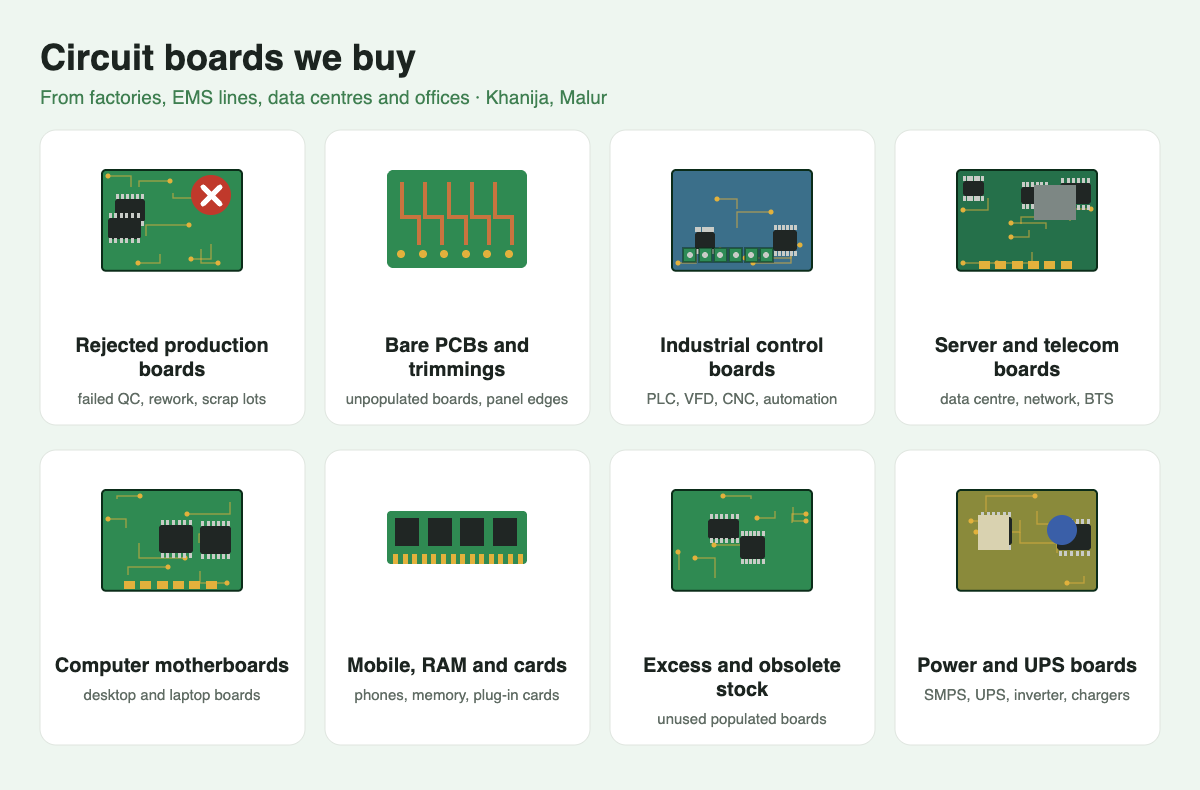
- High grade: server and telecom boards, mobile phone boards, memory modules and cards with gold edge connectors.
- Medium grade: computer motherboards, industrial control boards and most rejected production boards.
- Low grade: power supply, UPS, TV and appliance boards, where heavy transformers and heat sinks add weight but little precious metal.
- Bare PCBs: unpopulated boards and trimmings, valued mainly for copper, plus any gold or silver surface finish.
This is why sorting matters. A lot of mixed boards is valued at the level of its lowest-grade content, while sorted lots can be assessed for what each type really contains.
How the metals are recovered
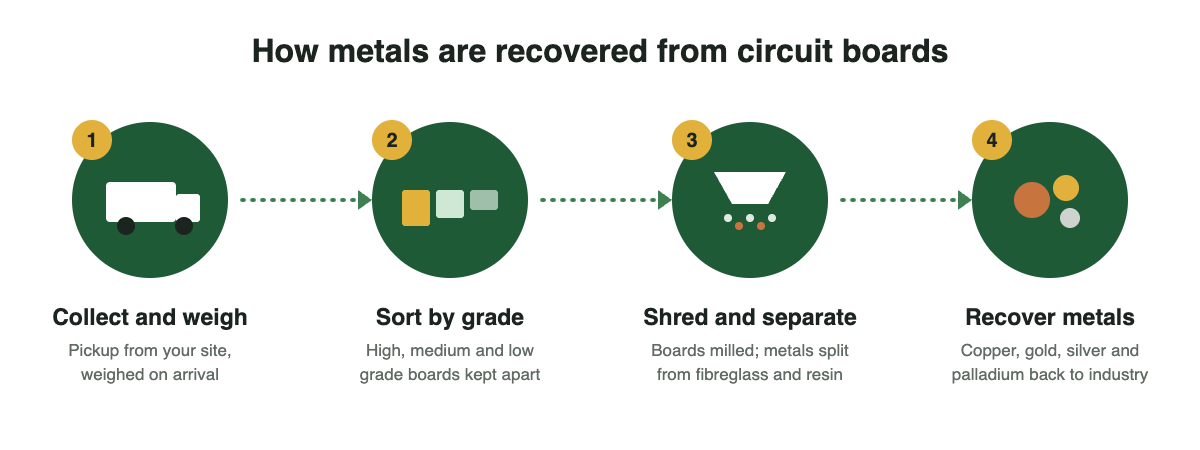
Responsible PCB recycling is mainly mechanical up to the point of metal recovery:
- Sorting: boards are graded, and batteries, steel brackets, heat sinks, cables and plastic housings are removed.
- Shredding and milling: boards are broken down into small particles so the metal is freed from the glass fibre and resin.
- Separation: density separation splits the material into a copper-rich metal fraction and a fine fibreglass and resin powder. The Materials study above found milling concentrates metal in the finer particles, and density separation produced a heavy, metal-rich fraction of about half the sample.
- Metal recovery: the metal fractions go on to recovery, so copper, gold, silver and palladium return to manufacturing.
The informal route and why to avoid it
A lot of board scrap in India still ends up with informal yards that burn boards in the open or strip them in acid baths. The World Health Organization’s fact sheet on e-waste lists open burning, heating and acid leaching among informal methods that release lead, mercury and dioxins, and names children and pregnant women as the most vulnerable. For a manufacturer, handing scrap to such a buyer also leaves no record of where it went.
What manufacturers should look for in a PCB recycler
- Weighment of every lot, with the weight recorded on both sides
- A price based on recovery value, explained by board type and grade
- Shredding of rejected and confidential boards, so failed units do not reappear in the grey market
- Documentation for every lot, kept with your EHS records
- Regular pickups for SMT and assembly line scrap
How to get more value from your PCB scrap
- Keep rejected boards, bare PCBs, motherboards and power boards in separate bags or boxes
- Remove batteries, steel brackets and enclosures where you can
- Keep boards dry and free of oil and chemicals
- Share photos and approximate weights so the buyer can assess the lot before pickup
Sell your PCB scrap to Khanija
Khanija Resource Recovery specialises in PCB recycling and precious metal recovery at our facility in Malur, near Bengaluru. We buy rejected production boards, bare PCBs, industrial control boards and other circuit board scrap from manufacturers and plants across India, pay a fair price based on recovery value, and facilitate 100% compliant disposal. You receive the documentation as per Pollution Control Board norms. See our PCB recycling service, book a pickup, or WhatsApp +91 99452 54009.