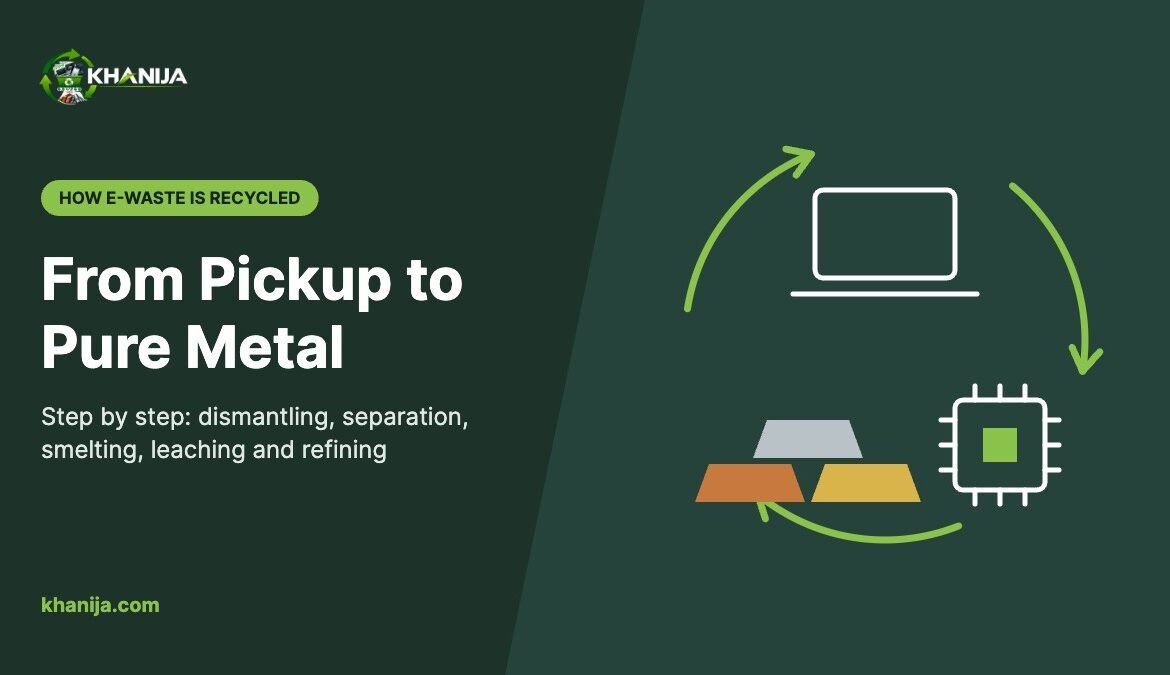
A laptop is mostly plastic, glass, steel and aluminium, with small amounts of copper, gold, silver and palladium on its circuit boards. Recycling it well means getting each of those back as clean material, while keeping lead, mercury and other hazards out of soil and water. Here is how that happens, step by step.
Step 1 and 2: collection, weighing and data destruction
Every lot is weighed and logged with its item type, because India’s E-Waste (Management) Rules, 2022 expect a clear record of what was handed over and how much. Before anything is opened, phones, laptops and servers go through certified data destruction: NIST 800-88 wiping where wiping is chosen, or physical shredding of drives when it will not.
Working devices are assessed for value
Devices that still work are assessed first. We check the model, age and condition and pay a fair price based on recovery value. Data-bearing devices go through certified data destruction, using NIST 800-88 wiping, degaussing or shredding as the client requires. Everything then moves on to recycling for material recovery.
Step 3: manual dismantling
Trained workers take devices apart by hand: circuit boards, batteries, screens, cables, motors and casings each go to their own stream. Manual dismantling is slow, but research reviews find it gives the highest recovery of valuable parts. It is also where hazardous parts are removed safely.
- Batteries are handled separately under the Battery Waste Management Rules, 2022.
- CRT glass from old TVs and monitors contains lead. CPCB guidelines describe cutting funnel and panel glass apart (hot-wire or diamond-wire cutting) and keeping leaded glass away from clean glass.
- Mercury lamps are crushed under vacuum so mercury vapour is captured, not released.
Step 4 and 5: shredding and mechanical separation
Mixed scrap is shredded and crushed into small pieces, then separated by the physical properties of each material:
| Method | How it works | What it separates |
|---|---|---|
| Magnetic separation | A magnet lifts out anything that sticks to it | Iron and steel |
| Eddy current separator | A fast-spinning magnetic drum creates currents in non-magnetic metals and throws them forward | Aluminium and copper from plastic and glass |
| Air or water (density) tables | Light pieces are blown or washed away, heavy pieces settle | Plastics from metals |
| Electrostatic separation | Metals lose an electric charge, plastics hold it, so they fall in different places | Fine copper from cable and board plastic |
Copper is not magnetic, which is why eddy current and electrostatic separators matter so much in e-waste recycling.
Step 6: getting pure metal back
Circuit boards and metal concentrates still hold a mix of metals. Four families of processes turn them into pure metal:
- Pyrometallurgy (smelting). Material is melted at high temperature. Copper, lead and nickel act as collectors that carry gold, silver and palladium with them, and the metals are then separated in further refining steps. Large integrated smelters, such as Umicore’s plant in Belgium, recover up to 28 different metals this way. It needs a lot of energy and strict gas cleaning.
- Hydrometallurgy (leaching). Metals are dissolved with acids or other solutions, then recovered by solvent extraction, precipitation or plating. It uses less energy than smelting and suits smaller plants, but the chemicals must be handled and treated carefully.
- Electrometallurgy (electrowinning and electrorefining). An electric current passed through a metal-rich solution plates pure copper, and other metals, onto an electrode.
- Biometallurgy (bioleaching). Bacteria and fungi dissolve metals from crushed boards. It is promising and low-energy, but still mostly at research and pilot scale.
Step 7: back into new products, and safe disposal of the rest
Recovered steel goes to steel mills, aluminium and copper to smelters and fabricators, and precious metals to refiners. What cannot be recycled goes to an authorised treatment, storage and disposal facility (TSDF), as the 2022 Rules require.
Why the informal route is a problem
Burning cables for copper or soaking boards in open acid baths recovers far less metal and exposes workers and neighbourhoods to toxic fumes. A TERI report supported by NITI Aayog (January 2026) estimates that formal facilities recover 95 to 97% of materials, against 10 to 20% in the informal sector.
Have old IT equipment, appliances or scrap to clear? Khanija handles corporate e-waste and IT asset disposal, industrial e-waste and PCB scrap, and pickup of old electronics from homes. Book a pickup or WhatsApp +91 99452 54009.
Sources: CPCB guidelines for environmentally sound recycling of e-waste; Umicore: how we recycle metals; MDPI Metals review (2024); Oke and Potgieter (2024); TERI / NITI Aayog (2026).